Making it personal
Slow yoga is not always gentle: how to ask for the pace you want
“Slow” can mean several different things: fewer changes of position, longer holds, more explanation or a quieter atmosphere. If you ask only for slow yoga, you may get one of those when you meant another.
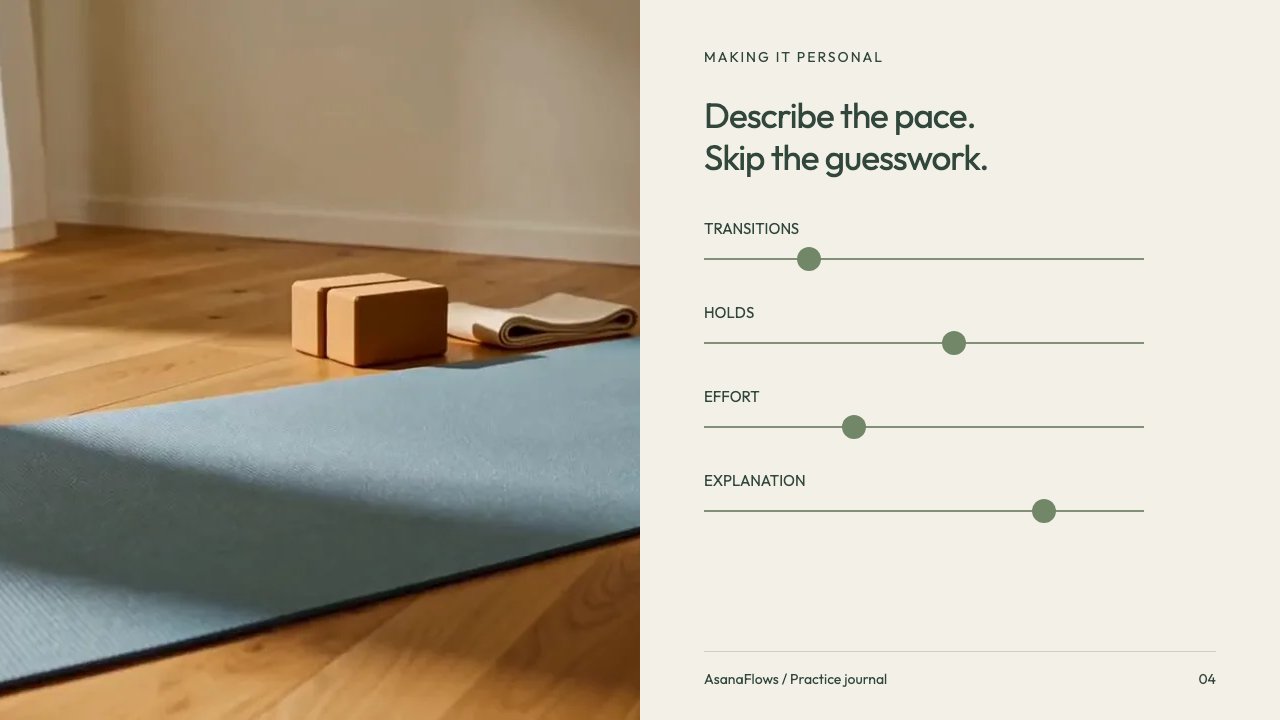
Transition speed: how quickly you change position
Think about the time between hearing an instruction and being expected to move again. Do you like a continuous rhythm, or do you want a pause to understand what is happening? That preference is different from whether you enjoy a particular pose.
When previewing a class, watch two or three changes in the middle. If the teacher announces the next step while you are still trying to understand the current one, ask for more time between transitions. You do not need to label yourself a beginner to request that.
Hold length: how long you stay
“Go slowly” may be interpreted as “stay longer.” Those are not the same request. A longer hold can give you time to notice what you are doing, but it may not be the kind of easy session you intended.
If you prefer frequent, unhurried changes, say so: “Keep the transitions calm, but avoid long holds.” If you want fewer changes and longer opportunities to settle, request that instead. Hold length should be described alongside the other demands of the class, not used as a proxy for its difficulty.
Effort: what you want from today’s session
A quiet voice and soft music tell you something about atmosphere. They do not tell you how much effort a sequence asks of you. Look at the movements and the way the class progresses, rather than assuming that calm presentation means a low-demand session.
Use ordinary descriptions: “I want a quiet break,” “I want sustained work,” or “I want to learn the sequence without rushing.” If a movement is unsuitable for you, changing its speed alone is not a reliable adaptation. Ask for a different option or individual guidance.
Explanation: how much talking helps you
A teacher can explain every detail while the class stays almost still, or use a few precise cues while movement continues. Either can work, depending on what you know and what you need to hear.
Decide whether you want pose names, step-by-step directions, reminders during holds or more silence. “Clear cues” is useful, but “explain where to move before starting the next transition” is more actionable. If you already know a sequence, you may prefer less repetition in the narration.
Compare two briefs, not two vague adjectives
A first brief might request continuous movement, familiar positions, short holds and minimal talking. A second might request fewer positions, time to set up and fuller explanation. Both could be marketed as slow yoga, yet they are different experiences.
Write down the version you mean before selecting a video. Then check whether the opening, middle and ending match it. This is especially useful when asking an app or teacher for a personalized practice: separate choices reduce the chance that a single adjective is interpreted in an unexpected way.
Give feedback in the same four dimensions
After a class, avoid stopping at “too boring” or “too hard.” Those reactions are real, but the next class is easier to improve if you can identify the cause. Was there too much waiting, too little instruction, an overly long hold or a transition you could not follow?
Change one or two things in the next brief. That lets you learn which adjustment helped instead of making every session different in every possible way.
Take this with you
Your next-practice checklist
- Specify transition speed.
- Specify hold length separately.
- Name today’s intended effort.
- Say how much explanation helps.
Questions & answers
Can I ask for a slow class that keeps moving?
Yes. Ask for unhurried transitions and short holds, rather than using “slow” alone. Then preview whether the lesson follows that brief.
Is gentle a standardized class level?
Do not treat it as a precise specification. Ask what movements, holds and transitions the class includes and what level of familiarity it assumes.
Your mat. Your time.
What would you like
to practice today?
Describe your practice Access by invitation.