Finding your class
Hatha, Vinyasa, Yin or Restorative: read the class beyond its label
A style name is a starting point for choosing a class. It is not a complete description of how that class feels. Two teachers can use the same label while offering very different pacing, explanation and transitions.
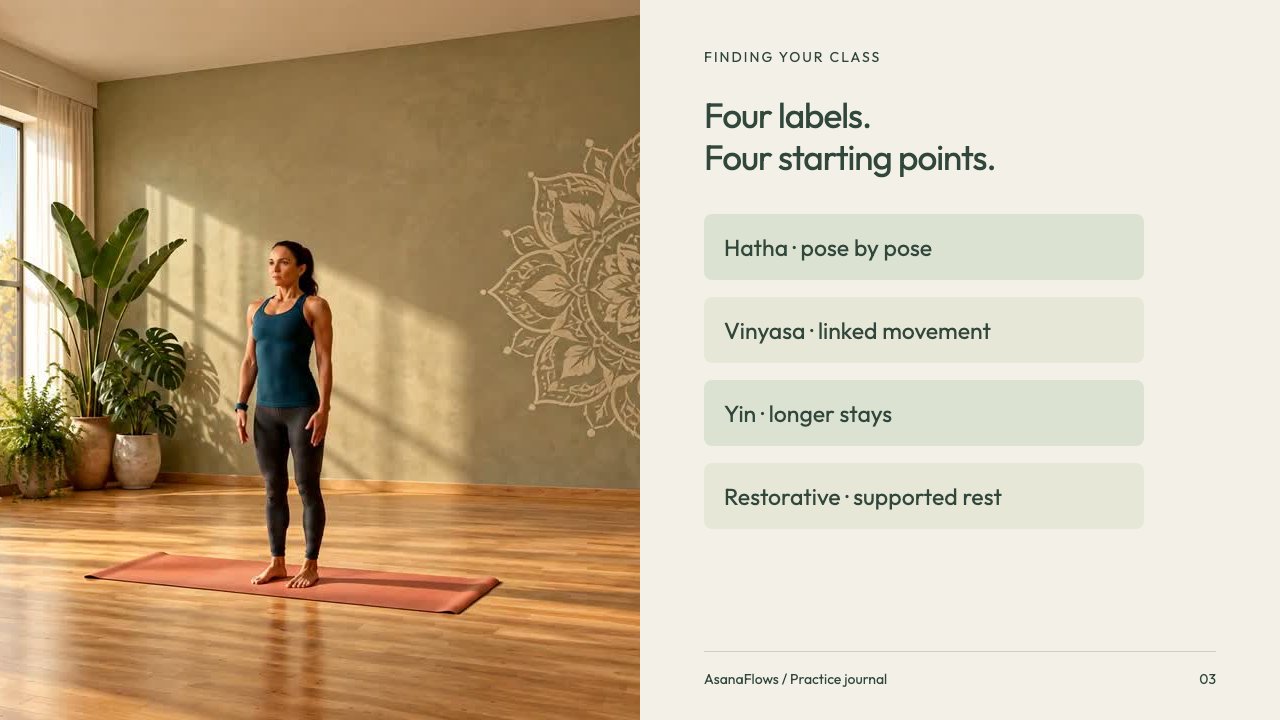
What the four labels commonly suggest
In class listings, Hatha often suggests a pose-by-pose format; Vinyasa usually emphasizes linked movement; Yin commonly includes longer stays in positions; and Restorative often uses props for supported rest. These are broad descriptions, not guarantees about a particular recording. University of Washington’s overview is useful background for this vocabulary.
Ask what happens between the poses
A list of postures says little about the experience between them. In a flowing class, the transitions may be a substantial part of the lesson. In another class, the teacher may pause to explain each new position or ask you to rearrange props.
Preview a transition in the middle of the video. Notice how many instructions arrive before the next movement begins. If you are learning the names as you go, a class that assumes familiarity can feel rushed even when its overall rhythm looks calm.
Separate stillness from effort
Longer stays do not necessarily make a class less demanding. A session can be slow and still ask for considerable concentration, sustained effort or a range of movement that does not suit your plans today. Likewise, a class with movement can feel straightforward when the transitions are familiar.
Instead of using “easy” as the only filter, ask for the details that matter to you: clear demonstrations, shorter holds, fewer floor-to-standing changes, more support or a less crowded sequence. Those requests are easier to compare with the actual lesson.
Read the equipment list before choosing Restorative
If a class is built around a particular support setup, the props are part of the teaching, not merely decoration. Check what is listed and how much time the teacher gives you to arrange it. A session may be calm once you are set up but awkward if you are trying to find a blanket halfway through.
If your available equipment differs, look for a class designed for what you have. Do not assume that every household object is an equivalent support or that leaving out a prop leaves the intended position unchanged.
Use a short preview instead of choosing an identity
You do not have to decide that you are a Vinyasa person or a Yin person before trying a session. Watch the opening and a short middle passage, then compare them with today’s request. The class can fit one day and not another.
If you enjoyed it, save the teacher, title and one concrete reason. “Clear instructions and time to get ready” tells you more about your preference than a style label alone. It also makes it easier to find an alternative when that particular video is not available.
Make the teacher part of the decision
Read who is teaching, what level they say the class is for and how they explain options. If you need an individual assessment, choose someone who can discuss that with you rather than relying on a category label. NCCIH advises using qualified instruction and discussing relevant health considerations.
Source: NCCIH: Yoga—Effectiveness and Safety.
Take this with you
Your next-practice checklist
- Use the label as a starting point.
- Preview transitions, not just a still pose.
- Check hold length and equipment.
- Save what you liked about the teaching.
Questions & answers
Is Hatha always a beginner class?
No. Class labels are not a guarantee of level. Check the stated audience, demonstrations and assumed familiarity in the particular lesson.
Are Yin and Restorative interchangeable?
No. Longer-held positions and supported rest describe different class intentions. Check the teacher’s description and equipment rather than treating both labels as synonyms for easy.
Sources & further reading
- University of Washington: Yoga Types and Benefits
Background on common class labels. This guide uses the format descriptions, not the page’s broader benefit claims.
- NCCIH: Yoga—Effectiveness and Safety
Background on evidence, limitations and choosing appropriate instruction.
Your mat. Your time.
What would you like
to practice today?
Describe your practice Access by invitation.