Your home setup
Yoga in a small space: set up the room before you press play
You do not need a room that looks like a studio. You do need to know where your body, your screen and the furniture will be during the class. A little preparation can keep a small room from becoming the main thing you think about.
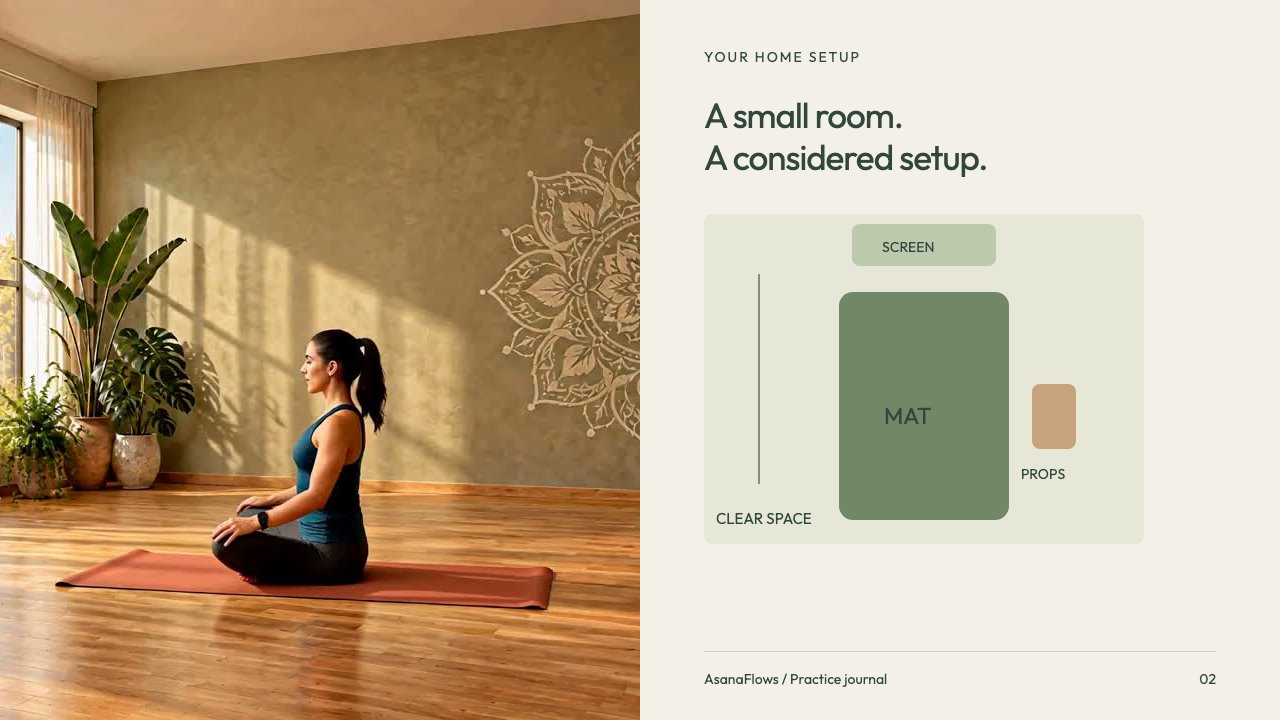
Check the space the class uses
Before moving furniture, look at the video description and preview its changes of position. Does the person stay along the length of the mat, turn sideways, reach outward or move away from it? The footprint of the mat is only one part of the space the session uses.
You do not have to rehearse unfamiliar movements to test the room. Look for obvious obstacles around your usual comfortable reach and walking path. If the session needs space you cannot clear, choose a different class rather than hoping it will work once you start.
Place the screen for the class, not the photograph
A laptop directly in front of the mat may work for one position and disappear from view in another. Use the opening and a middle section to work out where you will need to look. Put the device on a stable surface, away from the area you will move through.
Clear spoken instructions matter more when screen placement is awkward. If a recording requires constant visual copying, it may be a poor choice for this room. Avoid repeatedly twisting around to catch a demonstration; pause and reposition yourself or the device when necessary.
Treat sound as part of the setup
Check the voice at a comfortable volume before the class begins. Notice whether music obscures instructions and whether a speaker or earphones make the words easier to hear. Keep cables out of your movement area, and avoid a setup you have to adjust with every transition.
If you need captions, preview their size and placement on the device you will actually use. A class that is easy to understand on a large monitor can be difficult to follow on a phone across the room.
Give props a place to wait
Read the equipment list before you sit down. Put the requested items where you can reach them without crossing the room, while keeping the movement area clear. A prop that is technically in the room but tucked behind the sofa is not ready for use.
Do not improvise with rolling furniture, unstable stacks or objects that cannot support their intended use. If you do not have the equipment a class relies on, choose an equipment-free option or ask the teacher what alternative they intend.
Make interruptions an explicit choice
Tell the people you live with how long you plan to practice and which patch of floor you need. Put drinks, pet bowls and loose objects outside it. If the room is shared, a short appointment may be easier to protect than a long one.
You may still want to remain reachable. Set notifications accordingly rather than assuming that a successful practice requires complete silence. The useful setup is the one that matches your actual household.
Keep a reusable room note
Save a note alongside the classes that work here: “laptop on low shelf, mat lengthwise, no wide side steps.” It is information about your environment, not a restriction on every future practice.
When requesting a personalized class, describe that setup in ordinary words. “I have room for a mat but little space on either side” is more informative than “small apartment.” A plan can then be checked against the space before playback.
Take this with you
Your next-practice checklist
- Preview the space used beyond the mat.
- Place the screen and test the voice.
- Keep cables and unstable objects out of the movement area.
- Gather the exact props the class requests.
Questions & answers
Can I practice with only a phone?
A phone can be enough if you can hear the cues and see any information you need. Preview the class on that screen before committing to it; a readable caption or demonstration on a laptop may be too small on a phone.
Do I need a dedicated yoga room?
No. A repeatable setup in a shared room can work. The relevant question is whether the space, equipment and class match, rather than whether the room looks like a studio.
Your mat. Your time.
What would you like
to practice today?
Describe your practice Access by invitation.