Short practices
Is ten minutes of yoga enough? Start with what you want it to do
Ten minutes can be a complete appointment with your mat. The useful question is what you expect those ten minutes to contain. A quiet break, a familiar sequence and a lesson on an unfamiliar pose are different briefs.
Define “enough” before you choose a video
If you want to take a break from your screen, ten minutes gives you a clear boundary. If you want detailed instruction, several unfamiliar movements and a long final rest, the same window is crowded. Write the job of today’s practice in one sentence before you search.
Avoid asking a short class to prove its worth through intensity. The session can be useful because it fits your day and you can follow it. That is a practical judgment, not a promise that ten minutes produces a particular health result.
Count the time around the video
A ten-minute gap is not necessarily ten minutes of playback. Moving a chair, finding the video and putting your phone somewhere reachable are part of the appointment. If you have a hard deadline, choose a class shorter than the gap rather than planning to abandon its ending.
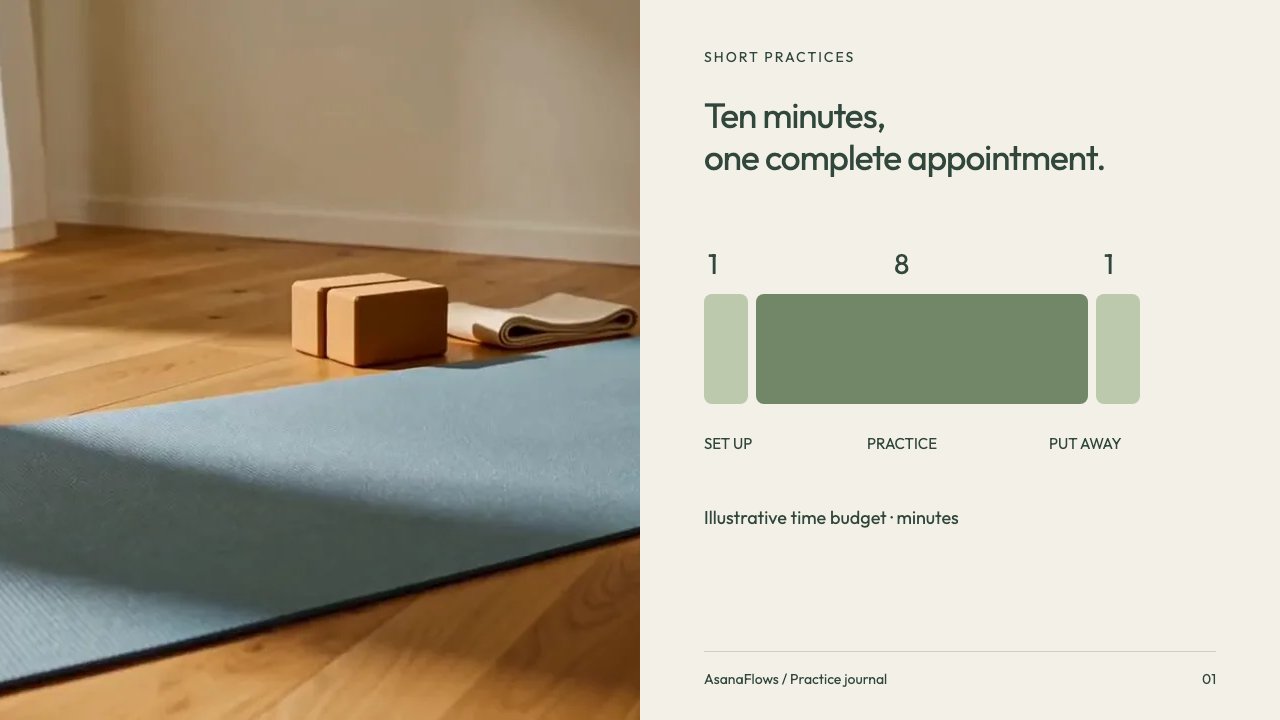
Try this timing sketch as a planning example: one minute to set up, eight minutes of playback and one minute to put things away. The numbers are adjustable. Their purpose is to make the entire appointment fit, rather than make the video length look impressive.
Keep the beginning and the ending
Preview how the teacher starts. Does the class tell you where to position yourself, what equipment you need and what kind of session is coming? A short arrival can be useful without becoming several minutes of waiting.
Then preview the last minute. Check that the class concludes rather than stopping in the middle of a series. There is no universal percentage that every short session must devote to stillness. What matters is whether the ending belongs to this class and fits the time you have.
Choose fewer things to learn
A class that changes position every few seconds may spend much of its short runtime moving you between instructions. If the movements are unfamiliar, try a clearly explained session with fewer changes. If the sequence is familiar, continuous movement may be exactly what you want.
For your first viewing, listen to a section in the middle before joining in. Could you tell what happens next without studying the screen? That small preview gives you more useful information than the number of poses in the description.
Keep weekly activity in perspective
A short yoga practice is one part of a week. The NHS describes separate aerobic and strengthening recommendations for adults; a particular yoga video should not automatically be counted as meeting all of them. Consider the rest of your activity rather than treating a ten-minute class as an all-purpose substitute.
Decide what to change next time
After the class, make a one-line note: “enough time, too much explanation” or “clear pace, wanted a longer finish.” Those observations tell you whether to change the length, the teacher or the brief.
If you consistently wish you had more time to settle, choose a longer window when it is available. If you consistently stop halfway through longer videos, a complete short class may be a better fit. Duration is a design choice, not a score.
Take this with you
Your next-practice checklist
- Name one purpose for the session.
- Allow for setup and putting things away.
- Preview one middle transition and the ending.
- Record whether you wanted more time or different content.
Questions & answers
Should I speed up a longer yoga video?
Choose a genuinely shorter class instead. Speeding up playback changes both instruction and movement timing, while cutting off the end may remove the class’s planned finish.
Does a short practice need to feel difficult?
Difficulty is not a requirement for making time to practice. Decide what you want from the session and choose a class that matches that purpose.
Sources & further reading
- NHS: Physical activity guidelines for adults
Context for weekly activity; a short yoga session is not automatically a complete exercise programme.
Your mat. Your time.
What would you like
to practice today?
Describe your practice Access by invitation.